Nahum Gardner
The Colour Out of SpaceNahum Gardner is a farmer whose initially fertile homestead becomes the center of a spreading, inexplicable disaster after a meteorite falls beside its well. First known as the genial owner of a prosperous farm and a local curiosity, he ends as one of the force’s victims, leaving Ammi Pierce with a fragmentary warning about the living color in the well and its hunger for life.
Identity and Background
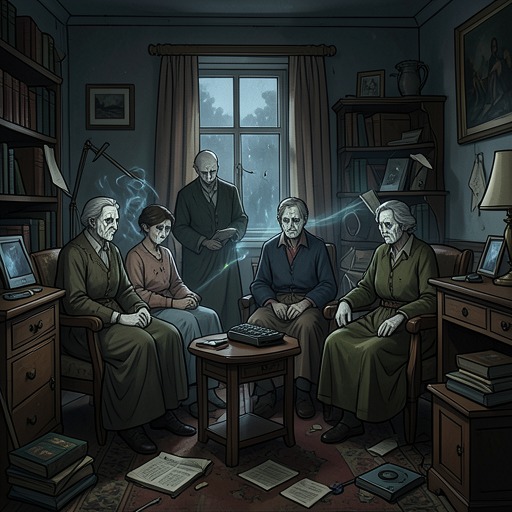
Nahum lives with his wife, Nabby Gardner, and their three sons, Thaddeus Gardner, Merwin Gardner, and Zenas Gardner, on a pleasant farmstead in the valley. He is lean, genial, and about fifty. Nahum and Ammi Pierce are close neighbors who visit one another frequently, as do their wives; Ammi later remembers him with unqualified affection. Before the meteorite, the farm’s white house, gardens, and orchards represent an ordinary, thriving rural life.
Nahum is about forty when he first tells Ammi of the strange rock that has fallen from the sky beside the well. The next morning, he accompanies three professors from Miskatonic University as they examine it. Its mound has already shrunk, though the professors say stones do not shrink; the material remains hot, is oddly soft, and can be gouged rather than chipped. A fragment taken away in a borrowed kitchen pail continues to burn through its bottom and grow smaller. Nahum’s observations place him at the first human point of contact with the meteorite’s impossible physical properties.
The Farm’s Altered Prosperity
News coverage makes Nahum a local celebrity, and he appears slightly proud of the attention. He talks frequently about the meteorite in the weeks that follow. Yet the farm’s new abundance carries a concealed cost. During the hot July and August, Nahum works hard at haying in the ten-acre pasture across Chapman’s Brook and finds the labor more tiring than in previous years. As harvest approaches, the pears and apples grow to extraordinary size, shine, and abundance, prompting him to order extra barrels. Their appearance promises a record crop, but every fruit is bitter and sickening to eat; the melons and tomatoes are spoiled in the same way. Nahum connects the blight to the meteorite and is relieved that most of the other crops grow in an upland field along the road.
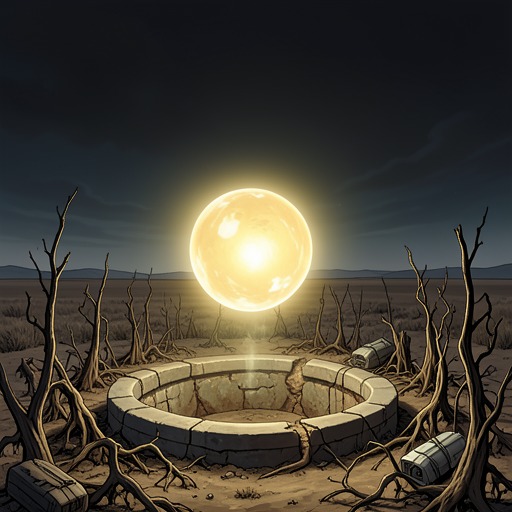
The meteorite itself vanishes after a thunderstorm. Nahum reports that lightning struck the furrow by the well six times in an hour; afterward, only a ragged pit, partly filled with fallen earth, remains. Digging yields nothing. The fragment taken to the laboratory also disappears within a week, leaving no residue and no useful explanation. The failure to find or understand the substance does not end its effects on Nahum’s household: his farm’s apparent fertility has become another sign of contamination rather than recovery.
Family Loss and the Well
In his final delirium, Nahum describes the force as a living color, like smoke, that burns while seeming cold and wet. He says it lived in the well and that the well shone at night. He associates it with the same uncanny color seen in the flowers and plants, and recalls a round object that the professors removed from the meteorite and smashed. In his account, that object had the color too; he suspects there may have been more of them, like seeds that grew. These are not calm observations: Ammi hears them from a failing man whose speech is broken and whose reasoning has become difficult to follow.
Nahum links the force’s growth to the disappearances and deaths in his family. He says that it became strong on Zenas, whom he remembers as a vigorous boy, and that Zenas never returned from the well. He also warns that Nabby’s face sometimes takes on the color toward evening and fears that the force will get her if they are not careful. By the time of Nahum’s last account, Thaddeus is already known to be dead, and Merwin and Zenas have disappeared. The family’s destruction is thus not a single sudden loss but an accumulating catastrophe, its victims associated in Nahum’s mind with the well and the draining of life.
Death and Aftermath
Ammi finds Nahum in the kitchen, alive only in a diminishing sense. Whatever has happened to him has advanced with terrible speed: in the space of about half an hour, collapse, greying, and disintegration have become pronounced, and brittle fragments are scaling away from his distorted face. Ammi cannot touch him. Nahum manages a final warning about the color’s power to consume life, but his speech stops as his body caves in completely.
Ammi covers what remains with a red-checked tablecloth and leaves by the back door. He cannot bring himself to pass the well. Looking at it from a window, he sees that no stone has been dislodged from its rim; he concludes that the splash heard earlier was not caused by the buggy, but by something entering the well after it had finished with Nahum. He then rides to Arkham and reports that Nahum and Nabby are dead, Thaddeus had already died, and Merwin and Zenas are missing. He gives the authorities little detail, describing the cause only as an illness like the one that killed the livestock. Their subsequent questioning brings him back to the farm with police officers and medical officials, a return he dreads as night approaches.
Narrative Role and Significance
Nahum’s fate marks the transformation of the meteorite’s effects from a baffling scientific curiosity into the destruction of a household. The shrinking stone, the vanishing fragment, and the splendid but inedible harvest all unsettle familiar measures of matter and growth; his dying testimony connects those changes to the well and to the family’s physical decline. The farm’s apparent abundance and its actual ruin form a stark reversal: what looks most fertile has become unfit to sustain life.
The reader receives Nahum’s explanation through Ammi’s recollection of a rambling, failing voice, not as a coherent scientific report. Ammi has to piece together the account and bridge gaps in its logic, so the testimony offers essential clues while preserving uncertainty about the force’s nature and intentions. Nahum’s affection for his neighbors and pride in his farm make that uncertainty intimate: the catastrophe is registered not only in strange matter and ruined crops, but in the disintegration of a man and the disappearance of his family.